
The answer depends on your kitchen, your renovation circumstances, and how much you value the particular advantages wall mounting provides. Understanding both the appeal and the reality helps you decide whether wall-mounted taps belong in your space.
The Design Appeal
Wall-mounted taps create visual impact that deck-mounted options struggle to replicate.
The clean counter, uninterrupted by tap bases and handles, reads as intentional and considered. The eye travels along unbroken horizontal surfaces while the tap itself becomes an architectural element emerging from the wall. This separation between water delivery and the worktop below creates a layered, designed quality.
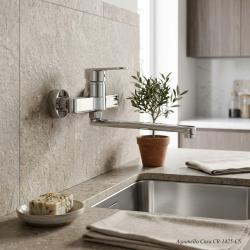
Vertical lines gain emphasis when taps mount on walls. The upward reach from sink to spout draws attention to backsplash materials, tile work, or wall finishes that might otherwise go unnoticed. In kitchens with beautiful stone, tile, or metal backsplashes, the wall tap becomes part of that visual story rather than a separate element sitting in front of it.
The professional kitchen association carries weight for many homeowners. Commercial kitchens use wall-mounted taps for practical reasons, and that connection lends domestic installations a serious, chef-inspired quality. The look suggests someone who cooks with intention.
Minimalist design philosophies embrace wall mounting naturally. When the goal is reducing visual complexity and eliminating unnecessary elements, removing the tap from the counter surface advances that aim directly.
Practical Benefits
Beyond aesthetics, wall-mounted taps deliver genuine functional advantages in daily cooking and cleaning.
Counter space increases when no tap occupies that surface. In kitchens where every centimetre of worktop matters, removing the tap base frees valuable preparation area beside the sink. The difference is modest in absolute terms but noticeable in daily use, particularly in compact kitchens.
Cleaning becomes simpler without tap bases creating obstacles. Wiping a continuous counter surface takes less effort than cleaning around and behind deck-mounted fixtures. The junction between tap base and counter, which inevitably collects grime and food debris over time, simply doesn't exist with wall mounting.
Water delivery positioning gains flexibility. Wall mounting allows the spout to extend further over the sink without the reach limitations that deck-mounted tap anatomy imposes. For deep sinks, large pots, and oversized cookware, this extended reach improves usability significantly.
Filling tall stockpots and pasta pots becomes easier when the spout sits higher and projects further forward. Deck-mounted taps sometimes struggle to clear the rim of deep vessels. Wall-mounted options position water delivery exactly where heavy cooking demands it.
Splash patterns can improve with proper positioning. When the water stream enters the sink at the right angle and distance, splashing reduces. Wall mounting allows fine-tuning of this relationship during installation rather than accepting whatever geometry deck mounting dictates.



Installation Realities
The advantages come with installation complexity that deck-mounted taps avoid.
Plumbing must route through the wall rather than simply connecting beneath the counter. This requires opening the wall, positioning supply lines precisely, and finishing around the tap escutcheons. The work is straightforward for experienced plumbers but adds time and cost compared to simpler installations.
New construction and major renovations accommodate wall-mounted taps easily. When walls are already open for other work, adding the necessary plumbing represents minor additional effort. The planning simply happens earlier in the design process.
Retrofit installations in existing kitchens present more challenge. Opening finished walls, routing new plumbing, and refinishing surfaces adds significant cost. The work may require tile removal and replacement, paint matching, or other finishing trades beyond basic plumbing.
Precise positioning matters critically. The mounting height, horizontal placement, and spout projection must align perfectly with the sink below. Mistakes are difficult to correct once plumbing is set in walls. Measure carefully, confirm with the actual fixtures in hand, and verify positioning before finalising anything.
Access for future maintenance deserves consideration. Some wall-mounted taps include access panels for valve servicing. Others require opening walls for any repair. Understanding maintenance requirements before installation prevents future frustration.
When Wall Mounting Works Best
Certain kitchen situations strongly favour wall-mounted taps.
New construction or gut renovations where walls are already open make the installation premium minimal. Plan for wall mounting from the start and the complexity largely disappears.
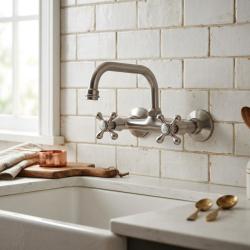
Deep sinks and farmhouse-style basins pair naturally with wall mounting. The spout can extend far enough over these substantial sinks to deliver water centrally without awkward positioning. Deck mounting sometimes struggles to achieve adequate reach for deep or wide sinks.
Statement backsplashes gain emphasis when taps mount against them. Beautiful tile, stone, or metal backsplashes deserve attention, and wall-mounted taps become part of that feature rather than separate elements sitting in front of it.
Professional-inspired kitchens suit the wall-mounted aesthetic. If your kitchen references commercial cooking environments through layout, equipment, or other design choices, wall-mounted taps reinforce that direction coherently.
Minimalist and contemporary kitchens where clean lines and uncluttered surfaces define the design direction benefit from eliminating tap bases from counters entirely.
Serious home cooks who regularly use large stockpots, preserve foods, or cook in volume appreciate the filling flexibility wall mounting provides.



When Deck Mounting Makes More Sense
Other situations favour traditional deck mounting.
Existing kitchens without renovation plans make retrofit wall mounting expensive relative to the benefit. The installation complexity may not justify the aesthetic upgrade alone.
Traditional and heritage kitchen designs often suit deck-mounted taps that carry appropriate visual weight at the counter level. Wall mounting can feel too modern for period-inspired spaces.
Budget constraints may not accommodate the premium wall mounting demands. Quality deck-mounted taps at lower total cost often serve better than compromising fixture quality to afford wall mounting.
Rental properties and kitchens you may not use long-term rarely justify the permanent investment wall mounting represents.
Pull-out spray functionality, common in many deck-mounted kitchen taps, appears less frequently in wall-mounted designs. If you rely heavily on spray features for rinsing and cleaning, deck-mounted options offer more choices.
Cost Considerations
Wall-mounted taps typically cost more than deck-mounted equivalents at similar quality levels. The fixtures themselves may carry premium pricing, and installation certainly adds expense.
Fixture costs reflect the engineering required for in-wall mounting and the escutcheon finishing that covers wall penetrations. Expect to pay 20 to 50 percent more than comparable deck-mounted options from the same manufacturer.
Installation costs depend heavily on whether walls are already open. During new construction, the premium is modest. During retrofit situations, the premium can be substantial, potentially doubling the total project cost compared to deck-mounted alternatives.
Long-term value calculations should factor in the design impact and daily usability benefits. If wall mounting achieves a look you genuinely value and solves real functional problems in your cooking routine, the investment delivers returns through daily satisfaction.
Positioning Guidelines
Proper positioning ensures wall-mounted taps function as well as they look.
Height should place the spout outlet 20 to 25 centimetres above the sink rim for most applications. This provides clearance for large pots while keeping splash distances reasonable. Deeper sinks may warrant slightly higher mounting.
Horizontal positioning should centre the spout over the sink bowl or slightly toward the primary work side if the sink has multiple bowls. Consider which bowl you use most frequently for filling pots and direct the spout there.
Spout projection must reach far enough to deliver water into the sink centre rather than against the near edge. Measure the distance from wall to sink centre and select a tap with adequate spout reach. Insufficient projection is a common mistake that undermines the entire installation.
Verify positioning with the actual tap before finalising plumbing. Hold the fixture against the wall at proposed height and confirm the spout reaches where you need it. Adjust before cutting into walls, not after.
Wall-mounted kitchen taps deliver genuine benefits in aesthetics, cleaning ease, and functional flexibility for serious cooking. They create the clean, professional look that design professionals appreciate and that transforms ordinary kitchens into considered spaces.
The costs are equally real: installation complexity, higher fixture prices, and potential maintenance access challenges. These factors don't disqualify wall mounting, but they require honest assessment of whether the benefits justify them in your specific situation.
For new kitchens, major renovations, and spaces where the design direction aligns with wall-mounted aesthetics, the answer is often yes. The marginal installation complexity during already-open-wall phases is modest, and the daily satisfaction is genuine.
For retrofit situations in finished kitchens, the calculation shifts. The substantial installation investment must justify itself against design goals important enough to warrant the expense.
Consider your circumstances honestly. Wall-mounted taps are worth it when the situation suits them. They're unnecessary expense when it doesn't. The distinction lies in your specific kitchen, not in any universal answer.


